
A look at The Conference
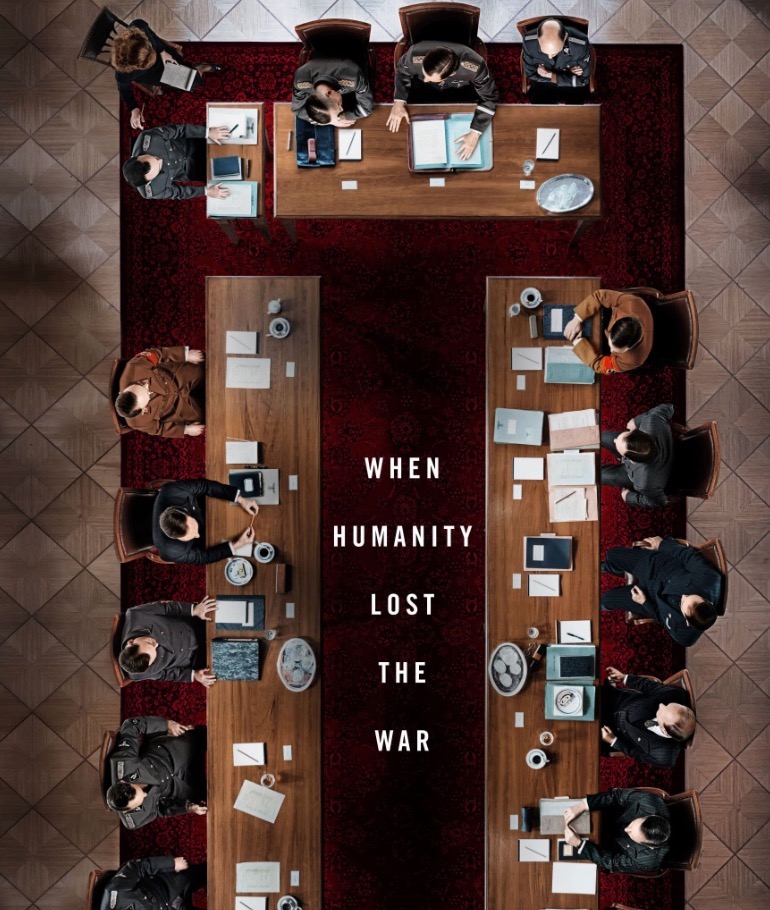
A movie based entirely about a meeting between 15 men and a lone female secretary shouldn’t promise anything out of the ordinary.
But in mid-January 1942, 15 Germans – particularly top military, SS, Nazi party and Gestapo officers – and also with half-a-dozen top civilian departmental heads there as well – meet to discuss how they were going to dispose of a large proportion of Europe’s Jews.
And when I say large I mean large.
They’ve been convened by the Fuhrer Adolf Hitler and Reichsfuhrer Heinrich Himmler to formulate a scheme to eradicate 11 million Jewish people living in Germany and its captured territories.
They discuss the various techniques for what is clearly straight-out murder as dispassionately as, say, what’s on the menu for dinner tonight.
The conference is all over in 90 minutes as the men gather outside a mansion in the beautiful outer Berlin lakeside suburb of Wannsee to say their farewells.
But back to the murderous conference.
Chair of the meeting is SS General Reinhard Heydrich, second in command to Himmler who’s the overall head of the SS (the Schutzstaffel or ‘Protection Squadron’).
Phillip Hochmair plays Heydrich with manners and grace, but alongside him Adolf Eichmann (Johannes Allmeyer) is a scowling, menacing-looking individual who can provide facts and figures when called upon.
Head of the Gestapo Heinrich Muller (Jakob Diehl) would gladly have taken the questioning civilian heads of departments out the back of the mansion and shot them.
Especially when one asks Heydrich what would be the fate of children born to one Jewish parent, and a German one.
Another department head asks what would happen to German Jews who had fought for the Motherland in the Great War. He was the only one present old enough to have fought in WW1.
And a top public servant expands on the earlier query – what about the quarter-blood Jews. Were they to be part of the Final Solution? Muller, of course, would have eliminated all of these non-Aryan folk. He’s interrupted by one civilian bureaucrat who brainstorms ‘forced sterilisation’.
Then there’s the most favoured method of getting rid of all these unwanted citizens. Muller mentions 11 million bullets could best be used on the front lines, in western Europe and in Russia. Not in mass graveside executions.
So a new form of gas is discussed, the disbursement of which would mean the involvement of far fewer soldiers, Einsatzgruppen or ‘murder squads’ and concentration camp guards.
The unwitting detainees would be ushered into what was called “a shower room” and the deadly Zyklon gas would be fed into the room from a vent on the roof.
Heydrich was a smooth talker. He never uses the terms ‘kill’ or ‘murder’. No. Himmler’s deputy uses terminology such as ‘special treatment’ and how to deploy the nation’s Einstazgruppen to the best advantage.
It’s absolutely chilling stuff. How well educated, mostly sophisticated and family-oriented men could have talked about murdering 11 million people is beyond comprehension.
And the only way we know what was discussed comes from the unearthing of Eichman’s studiously typed-out minutes, with his hand-written notes in the margins, discovered two years after the war ended: in 1947.
Incidentally the conference chairman Heydrich, who was not quite 38 at the time the 15 senior Nazis met, was assassinated only a few months later: in June 1942. Anti-Nazis gunned him down in his open-topped Mercedes in what is now the Czech Republic capital Prague. Heydrich was serving there as Hitler’s appointee with the title of Reichsprotektor (or Governor). The country was then known as Bohemia and Moravia.
My rating: I’d give The Conference three-and-a-half stars out of five.
 australianrules.com.au