
A look at All Quiet On the Western Front
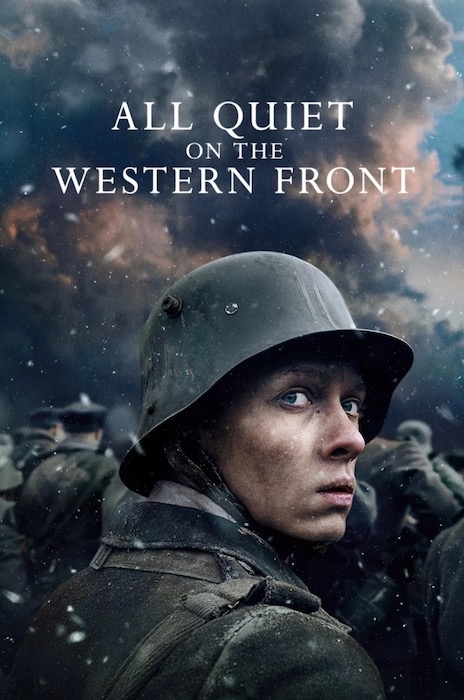
When you look back at war films you’ve seen not too many are told from the enemy viewpoint.
Tora Tora Tora devotes a fair bit of time to the Japanese pilots and air crews responsible for the surprise 1941 bombing attack on the US fleet stationed at Pearl Harbour in Hawaii.
But it’s only partially about the Japanese military.
In director and co-writer Edward Berger’s World War 1 film I’m reviewing here everything is based around some of the young men in German infantry battalions stationed on the French front lines.
Spurred on by their eccentric, ultra patriotic secondary school headmaster Paul (Felix Kammerer) signs on with his classmates in a surge of patriotic fervour.
Patriots these teenagers might be, but they’re also extremely naïve.
Paul’s comrades-in-arms are Muller (Moritz Klaus), Kropp (Aaron Hilmer), Tjaden (Edin Hasanovic) and most vitally the older and more experienced professional infantryman Katczinsky, or ‘Kat’ (Albrecht Schuch).
Kat turns out to be the elder ‘brother’ for the young men and he’s fiercely protective of their rights, such as rights to regular, hearty meals.
How tough things have become in 1918 Germany is clear when we see that the uniforms of dead soldiers are stripped from the corpses, re-sewn to repair any tears or holes and assigned to the new signees.
Paul feels the name tag of the dead soldier whose uniform he’s wearing rubbing against his neck.
Kat tears it off and tells the new soldier to keep going. We eventually find out that Kat’s illiterate so the young, well-educated new infantryman Paul reads aloud a letter from his wife which outlines a devastating family tragedy.
And where does this ‘reading’ take place? While the pair are seated together on the log over the latrine trench, a correct feature of WW1 that director Edward Berger knew all about.
Paul and Kat know that a nearby French farmhouse to their barracks would be a great source of fresh food, poultry in particular, so they raid the farmer’s barn.
The first raid goes beautifully. But on the return excursion tragedy strikes when Kat goes into the forest for a ‘nature break’ leaving the geese and ducks with Paul.
As he turns around the farmer’s teenage son strikes. He fires both barrels of a shotgun into Paul and then careers off back home.
Paul manages to carry the mortally wounded Kat back to the barracks after being ignored by drivers of troop-carrying trucks which pass the pair by.
And Tjaden is in the military hospital jabbing at his neck with a knife once he realises he’ll have to go through what remains of his life as an amputee.
While all this going on, German politicians and civic leaders are meeting with their French counterparts close to the front.
In a railway carriage in Compiegne. Leader of the German delegation is Magnus Erzberger (Daniel Bruhl) who’s ready to sign the capitulation on the Kaiser’s orders.
But French Marshal Foch (Thibault de Montalembert) is contemptuous and rude when the Germans offer concessions.
He’ll have none of that and waves away any protocols endorsed by Erzberger. He gives him a 72-hour deadline to complete the peace treaty signings.
Eventually compromises are reached and the German surrender is set down for 11am on the 11th day of the 11th month: 11th November, 1918.
But it’s not going to be quite over for Paul and his frontline fighters.
An enraged, semi-psychotic German general declares to his exhausted battalions that there’s still time for one last battle “to save the Fatherland’s honour.”
Hearing some dissent from Paul’s mates who have heard that the truce signing has been completed, the general orders his military police into action.
The grumbling infantry men are taken to the front of the parade and shot by the military police. In full view of their comrades.
So off the German foot soldiers go into battle one last time, across ‘no man’s land” and tumble into the French trenches.
It must be around 10.40 or 10.45am or so as Paul ends up in a shell hole with a wounded French soldier and feels he should end the man’s suffering.
But then Paul regains his feet and makes one last charge at the French trenches. It’s about one or two minutes to 11 when the war ends for our Western Front protagonist deep inside an enemy trench.
Not surprisingly given its huge release hoopla, All Quiet On The Western Front has been nominated for nine Academy Awards.
These include Best Picture Oscar (producer Malte Grunert) and it’s one of 10 nominations in that category, best cinematography, Best International Feature Film, make-up and hair styling, music (original score) and production design.
Then there’s best sound, leading visual effects and best writing, as an adapted screenplay, to take the Oscar possibilities to nine.
The Academy Awards evening will be seen on our Aussie screens on 13 March. I’d give All Quiet On the Western Front four stars out of five.

