
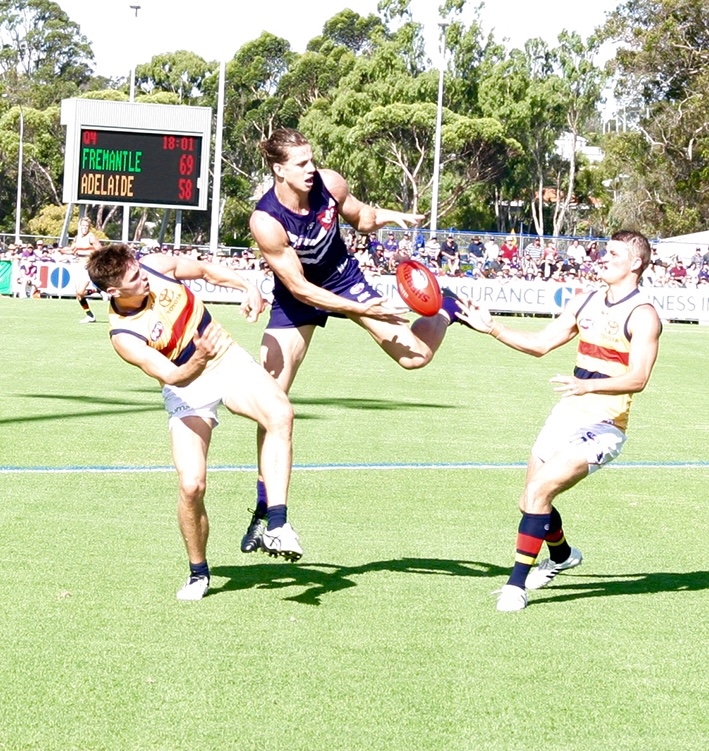
• In action in a pre-season game at Mt Barker WA in 2016. All photos by Les Everett
I’ve only had one encounter with Nat Fyfe. It was kind of like a speed date.
Just about everything was done for the 20-year history of the Fremantle Dockers – a book that was one win away from the perfect ending. But there was a section subtitled Club Heroes – captains, Doig Medal winners and All-Australians. The Doig Medal winner for 2013 hadn’t been decided and I wasn’t going to be told ahead of time. If it was a new winner I’d be given a few minutes to get enough information for a story in the book.
Fyfe won his first Doig Medal and after a press conference with the real media was ushered into a room for an interview for the book.
Two contrasting comments have stuck with me and both say a lot about this young man. When told by the club’s media boss Luke Morfesse that he was to first have an interview with me before celebrating with family and team mates he said, “Wow, I am gonna be in the book?” They were the words of a humble country boy. During the interview he talked of how much he’d learned in Lake Grace from his next-door neighbours Mitch, Jarryd and Cale Morton who all became AFL players: “They were a lot older and more skilful than me so I learned a lot from them—you had to come up to their grade quickly otherwise you didn’t hang around for long.”
But then when reflecting on the fact he’d just been named an AFL club champion in a Grand Final season, his words were those of a driven and professional sportsman: “I’ve always had strong goals and strong focuses. This is where I envisaged myself being at some stage.” He wasn’t a dual Brownlow Medal winner yet, but there was a sense he wouldn’t have thought such achievement beyond him.
Fyfe was articulate, interesting and precise in his responses and quick to acknowledge team mates, coaches and support staff for his success. All good for the in-their-own-words style for the book.
After winning the Doig Medal again along with the AFL’s Brownlow Medal in 2014 and 2019 injury sent Fyfe’s career into a slow decline. In the four seasons from 2020 to 2023 he played just 45 games. Kicking was an issue when he did play. Kicking for goal seemed traumatic.
Something like full fitness retuned in 2024 and Fyfe played 22 games as a kind of big support act in the midfield for young guns Andrew Brayshaw and Caleb Serong and later Hayden Young. It was different, useful and selfless – he was “playing a role”.
After eyeing a top four spot Fremantle lost their last three games and didn’t make the finals. In the last game of the season against Port Adelaide Fyfe looked like he couldn’t keep up… I wasn’t only the one who thought his time might have come. I think he did too. But just before half time there was cause for a rethink. Fyfe outpointed an opponent in the goal square, pulled in a one-handed mark and kicked a goal. Maybe he could go on.
More injury in 2025, a couple of appearances in the WAFL, then a new useful job as substitute and an end-of-season retirement announcement.
Nothing left to prove. Lots more to gain.

• After the Grand Final 2013.
Fremantle Dockers an Illustrated History by Les Everett was published by Slattery Media and the Fremantle Football Club in 2014.
 australianrules.com.au
Wonderful tribute Les. Fyfe is one of the best players I’ve watched in the last 20+ years. Thank god he didn’t have his goal kicking boots on late Sept 2013. He strikes me as a level headed guy. Cheers
Fyfe’s a frickin champion, and it appears, a decent bloke. Great tribute Les