
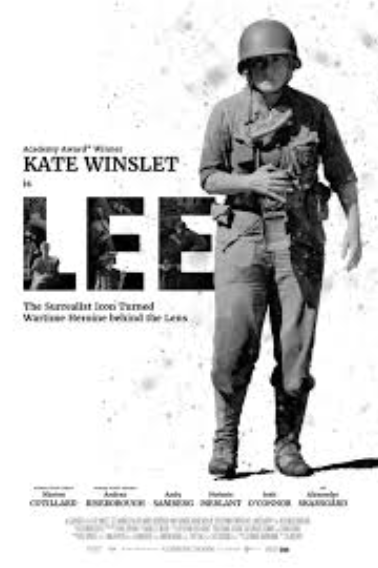
A look at Lee (R)
As model turned topline war photographer Lee Miller, Kate Winslet captures Lee’s confrontational, tough outer skin mixed with her magnetism as a former high fashion model perfectly.
The film starts when she’s in her late 60s being interviewed by a much younger man (Josh O’Connor) and that to-ing and fro-ing marries together Lee’s war memories.
At the start I thought that the interviewer was a print media journo, but not till the film was 75 percent finished did I realise it was Lee’s actual son.
We first see Lee Miller at a bohemian late 30s pool party in Paris just before war breaks out.
She’s there, topless to start with, along with another topless girl plus a roll call of world celebrities: famous photographer Man Ray, to whom she was married later in life, and celebrated artist Pablo Picasso.
We also see Lee in the immediate pre-war London office of Vogue magazine, for whom she works, and she’s with her friend and editor Audrey Withers (Andrea Riseborough).
Another famous face pops up briefly in the Vogue office shots. It’s another photographer who will become world famous, too – Cecil Beaton.
But it was when World War 2 was closing out that Lee’s photographic skills really excelled and took off.
With Life magazine photographer Davy Scherman (Andy Samberg) they travel in a US Army jeep across all sorts of war zones, frantically snapping away every day.
At one stage they go a whole month without a shower or a bath making Lee’s soaking in Hitler’s private bathroom adjacent to his Berlin office even more memorable.
She makes sure Andy snaps her as she breaks the glass on a framed Hitler bathroom portrait and dunks the photograph straight into the bath water.
But before they reach Berlin the two acclaimed photographers are some of the first civilians to access the Nazi concentration camps at Buchenwald and Dachau.
What they saw and snapped there must have stayed indelibly imprinted on their memories for the rest of their lives. We see Lee in her last years fossicking, wordless, through her own contacts and prints at home in England.
And as someone who passed through Dachau just outside Munich in the early Seventies – only a quarter of a century after it was liberated – the giant ovens where the inmates’ bodies were crammed in on metal ramps and incinerated will never leave my memory either.
Lee was also an early feminist. In post-war Berlin she comes across an Allied forces soldier who’s pinned a girl against a suburban wall.
She hauls out her Army knife, threatens the soldier who then runs off and then hands the weapon to the terrified girl.`
“If this happens to you again, use the knife to cut it off,” she advises the local girl.
Director Ellen Kuras, a cinematographer herself, uses stark differences in colour from the bright, frivolous hues around pre-War festivities to the harsh greys and even light blacks of destroyed Berlin and the concentration camps.
This is one of the best movies I’ve seen in the past 12 months and that list includes Oppenheimer, Wicked Little Lies and Napoleon.
My verdict: Four-and-a-half stars.
 australianrules.com.au