
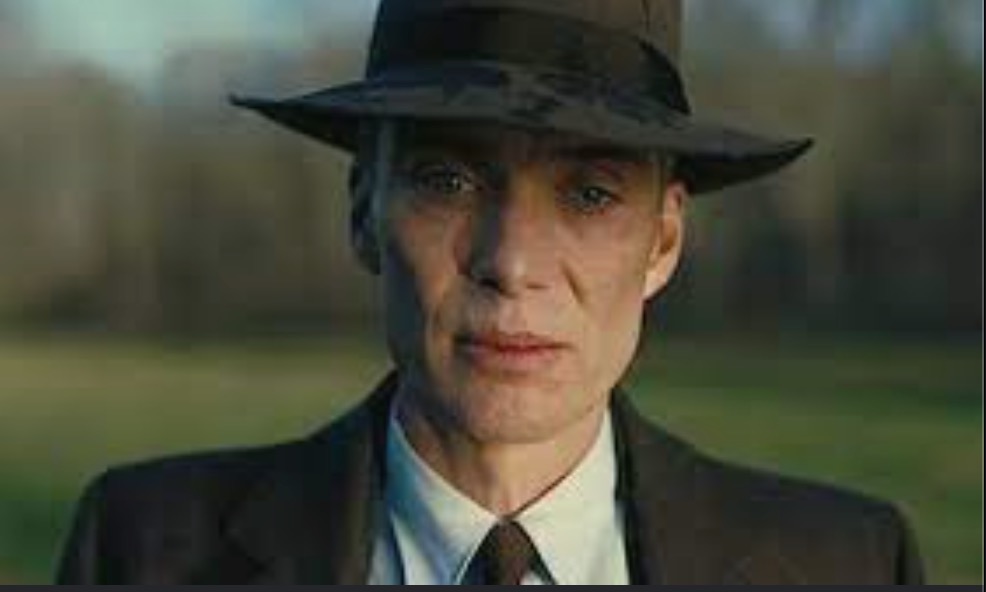
A look at Oppenheimer (MA 15+)
How should we regard brilliant scientist J Robert Oppenheimer, the brain behind the invention of the planet’s first atomic bombs. Was he a 20th century Frankenstein or just a highly motivated inventor?
Well, director Christopher Nolan weaves into his story, as he’s done many times before, a patchwork of events: frantic studies in various universities, courtroom dramas, romantic liaisons, lecture hall cult worship and of course, Eureka moments in laboratory findings. We even get to see a naked Oppenheimer (Cillian Murphy) with his lover Jean Tatlock (Florence Pugh). Fortunately he’s sitting, legs crossed, in an armchair while Jean reclines on a bed.
They’d both been pre-WW2 supporters of the anti-fascist Republicans in the Spanish Civil War and completely opposed to genocidal German Nazism. This affiliation comes back later to haunt him as he’s hauled up in 1954 before the US Atomic Energy Commission where he’s stripped of his national security clearance after his pre-war Communist sympathies were revealed.
The major protagonist here is Lewis Strauss (an excellent Robert Downey Jr) who as chairman of the AEC is focused on bringing Oppenheimer back to ground zero. And he succeeds although some of the closed-door hearings leading up to the Commission’s sittings probably roll on a tad too long.
But back to the Manhattan Project in the New Mexico desert. Oppenheimer knew the US was facing a race against time as he’s convinced his brilliant pre-war German lecturer Neils Bohr (Kenneth Branagh) would be working flat-out on a similar project for Hitler. Oppenheimer’s US military liaison officer Lt General Leslie Groves (Matt Damon) is very pushy as he’s well aware, like Oppenheimer and his inner-circle scientific team, that as the early 1940s unravel they must arrive at the invention first. Groves is with Oppenheimer a lot of the time -– at the Manhattan project’s hastily built town, at conferences and on long train trips back to Washington.
And in the capital city Oppenheimer even gets to meet genius scientist Albert Einstein. The pair meet beside a city lake and Einstein (Tom Conti), replete with white hair and long, white moustache) wishes Oppenheimer the best of luck even though he’s not within the inner circle’s studies and findings.
So how were the final Japanese target cities arrived at?
One senior bureaucrat at the top-secret meeting said he wanted the panel to rule out Osaka because he and his wife had enjoyed a great honeymoon there. Bizarre, but true. So under General Groves’ push, Hiroshima and Nagasaki end up as the overwhelming choices for the Trinity-perfected bombs to fall upon.
Eventually the July 1945 countdown begins. It’s time for the world’s first atomic bomb test to go ahead. Unexpected rain around the New Mexico location, and statewide, delays proceedings for 48 hours but Oppenheimer isn’t fazed. As a ranch owner himself in New Mexico he knew that desert rainstorms weren’t going to last a whole week. So finally the July countdown begins. There’s some protective sunglasses or eye coverings among the crouched military people and scientists, with one soldier even smearing on some colourful facial ointment.
We finally get to the “three, two, one – go” and the atomic bomb explodes. Nolan’s special effects people excel themselves as it’s a key moment in the movie.
And the rest, as they say, is history. A month later the two atomic bombs detonate over Hiroshima and Nagasaki and the Japanese reluctantly have to surrender. A quarter of a million people are dead or permanently disfigured, including a handful of Allied prisoners-of-war in both cities.
Oppenheimer does eventually get to meet President Truman in the White House’s Oval office to express his views. When the Manhattan Project boss expresses his mortification over the deaths of tens of thousands of everyday civilians Truman (Gary Oldman) tells the atomic scientist that the final outcome rests with him: the President. It’s not the responsibility of the Manhattan Project scientists and their test site crews Truman informs him. And at the end of interview the president admonishes Oppenheimer: “Don’t be a pussy-cat.”
And, yes, we get a few brief scenes involving the real Soviet spy who was on-site in the New Mexico desert. Klaus Fuchs (Christopher Denham) is seen in university laboratory shots and later on-site at the Manhattan Project. Fuchs, of course, served nine years in US prisons after being convicted and then spent his later years in Great Britain.
But there’s only a handful of scenes involving women. Lover Jean I’ve mentioned but Oppenheimer’s wife Kitty (Emily Blunt) is only seen occasionally. She’s partial to Martinis and often neglects their crying, unhappy baby.
And it took me a few minutes to become used to Murphy as an atomic scientist. I vividly recall him as the prime gang boss in 1920s Birmingham in the TV series, Peaky Blinders.
So, after three hours, what rating would I give Oppenheimer? Well, I’d give it four stars. It’s a really excellent movie and the surround sound for the New Mexico desert test site explosion is mind-blowing. As a military person on-site commented: “You see it, then hear it and finally feel the ground moving.’ You won’t experience that frightening sound on your home TV set on Netflix, Binge or Amazon Prime.
But at the cinema get ready for a three-hour movie.
 australianrules.com.au