

An excerpt from The Footy Jumper Book by Tim Rath & Andrew Gigacz
For a time in the early 1970s, lace-up footy jumpers became somewhat of a trend in the VFL, one apparently sparked by Richmond’s Craig McKellar in 1971. McKellar had come to Punt Road from SANFL club Woodville, and he wore a Woodville lace-up guernsey to training, piquing the interest of his new Tiger teammates.
Melbourne is often seen as trendier than Adelaide, but here the City of Churches was well ahead of the fashion curve. A manufacturer named Vic Hill had begun producing lace-up guernseys in the late 1950s, and many of the SANFL clubs adopted the ‘new’ style.
That Vic Hill-led revival has left a false historical impression that lace-ups were returning to footy fields for the first time in a half a century. In truth, the lace-up had been making sporadic comebacks almost from the time they had first disappeared. The ‘lace-up jacket’ as it was sometimes called certainly had a renaissance in the early 1930s in the three big footy states.
North Adelaide led the revival, announcing in 1930: “the committee has decided that a lace-up jacket of linen shall replace the former guernsey. With the alteration of rules our committee thought it would be of advantage to return to that style. Opponents will not be able to hold the jackets so easily.”
A year later, fellow SANFL team Port Adelaide followed suit, wearing lace-ups made of serge, and soon the ‘retro’ jumpers had spread west to Perth. All but one of East Fremantle’s players are wearing lace-ups in the 1934 team photo.
In Victoria, five South Melbourne players donned lace- ups for the Swans’ semi-final win over Collingwood and were impressed enough to recommend others wear them for the remaining finals. Star full forward Bob Pratt was particularly in favour of them, claiming the lace-ups prevented the “old dodge” of full backs holding opponents by the guernsey as they pre-pared to leap.
Oddly, by 1936, the lace-ups were once again falling from favour. The Australasian reported in August of that year that Port Adelaide had “abandoned the old lace-up guernseys”. Within 20 years, though, Vic Hill would spark another revival.
After several of Craig McKellar’s Richmond teammates made the switch, the lace-up fad soon spread to players of other VFL clubs. Don Scott flirted briefly with a lace-up jumper in the early 1970s. “I think it was 1973 or 1974. Port Adelaide and Sturt and maybe some other SANFL clubs were wearing them at the time. I think it was [Hawthorn teammate] Bruce Steven- son who organised it. Bruce and Leon Rice each had one and we wore them at training, but I was the only one who wore a lace-up in a game.”
Scott had already had some misgivings about the lace-up when he pulled it on for the match against Footscray. He liked tucking his jumper in to his footy shorts but his lace-up was too short for that. “That’s the way they were designed. Anyway, I had extra length added to mine.”
Even then, the jumper didn’t feel quite right. “They didn’t quite get the colours right and the jumpers didn’t have much ‘give’. I wore mine at training a few more times but never again in a match.”
Scott also remembers the lace-up causing problems for opposition players. “David McKay recently told me he’d injured his finger after it got caught in a lace-up jumper.” McKay confirmed this. “Yes, it was in 1970. We were in Adelaide playing against Sturt as part of the national championships. I got my finger caught in ‘Diamond’ Jim Tilbrook’s jumper. Tilbrook was hard enough to tackle at the best of times, but the tight lace-up jumper made it almost impossible.”
In 1987 Melbourne champion Robbie Flower broke his finger the same way, his ring finger caught in Kangaroo Matthew Larkin’s lace-up. The break was so severe that Flower was sidelined for over a month, and he missed the Demons’ Night Grand Final triumph over Essendon, the only piece of silverware the club collected during his illustrious career.
It was this injury, and another to teammate Brian Wilson, that led to the outlawing of the lace-up.
• THE FOOTY JUMPER BOOK; Vintage football guernseys of Australia. 320+ guernseys from the 1890s to 2000s, showcasing the history & tradition of a revered aspect of Australia’s game. Features foreword by Martin Flanagan. RRP $90 – free express post PRE ORDER NOW https://sportingnation.com.au/pages/footy-jumper-book
 australianrules.com.au
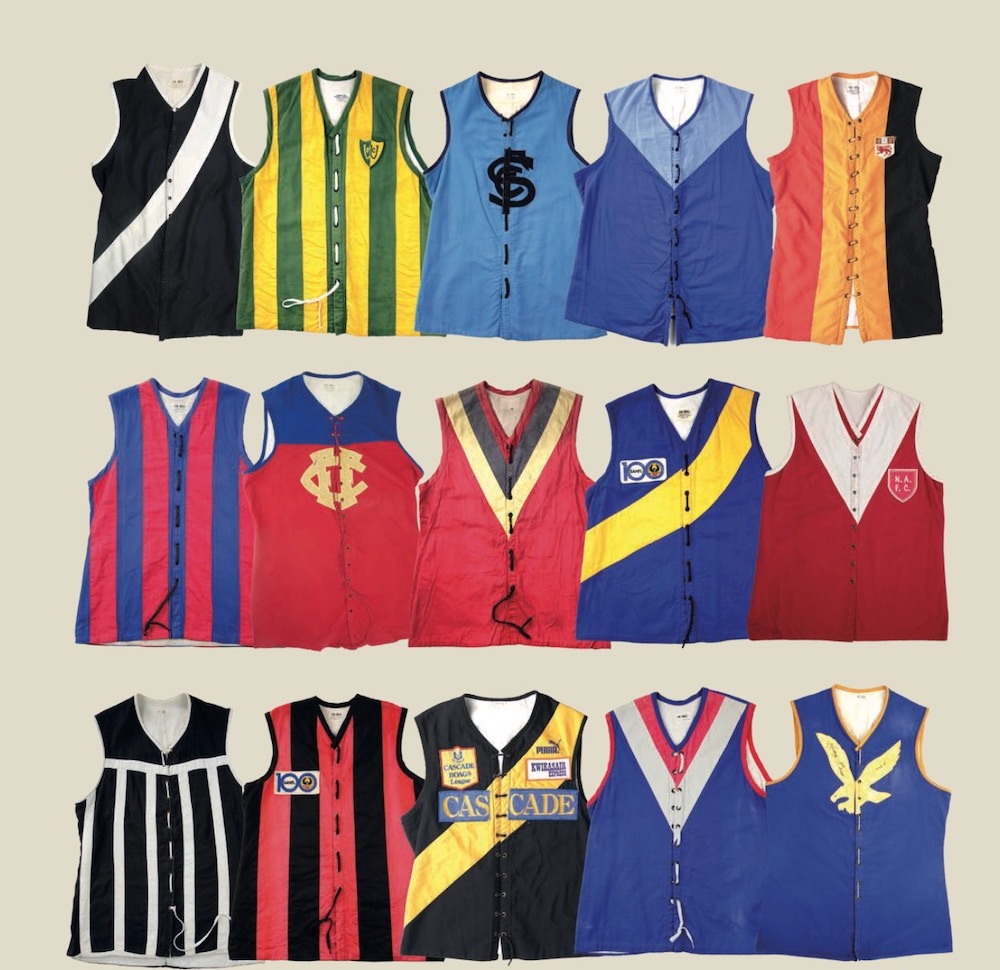
The all-black with a white stripe gurnsey ( top left in photo) is still the playing gurnsey of the Oakleigh District Football Club, in S.E. Melbourne. Currently, it is still the only Club in Australia to have that design. The ODFNC also adopted the lace-up style ( from Vic Hill in Adelaide ) in the late 70’s, early 80’s, because they were warm and comfortable, and it was very difficult for the wearer to be tackled. The ODFNC adopted the unique all-black with a white stripe uniform design in 1964, when they moved from the SESFL to the Federal F.L., and after wearing the Collingwood gurnseys from their formation in 1949. The Clayton FC in the FFL, already had the Collingwood gurnseys.
Love the lace up jackets, my first was a Sturt lace up in 1974 with the number 2 on the back who was Keith Chessel, later I started buying the West Torrens lace up jackets with the number 9 Aldo Floriani on one and number 7 Forsyth on the other, the material is so much better than the polyester of today.