
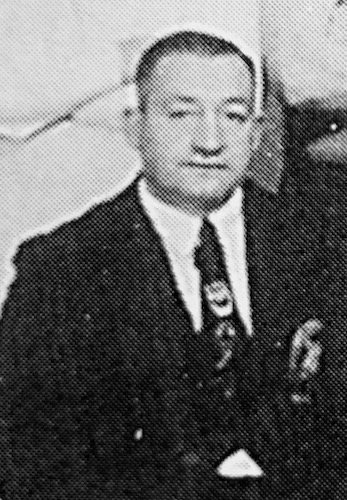
Club in 1948.
In 1993, when I was researching for my book Gravel Rash, Boulder Football Club identity Max Viskovich took me to visit Pom Holland. The story didn’t make it into the book. Probably should have. Here it is.
Arthur ” Pom ” Holland sat at the kitchen table in his humble little Boulder house. The late afternoon sun shining through a window lit up the right side of his face. He’d been a handsome bloke in his younger days, you could see that. Now he was approaching 90-years-of-age and a bit unsteady on his feet.
He used to like a beer but he refused the one we offered him. “Haven’t had a beer in 12 months,” he told us, “don’t even feel like it any more.”
Arthur was born in Yorkshire, he was 13 when his family moved to Australia in 1916. He spent a short time at the Boulder Primary School and there picked up the nickname that was to stick. “Don’t write about Arthur,” he said, “or half the people who know me wouldn’t know who you were talking about.”
Pom was not a great footballer but he can lay claim to a proud and possibly unique record; he was captain of the Kurrawang football club’s first premiership team, he captained the first Moonta Turks premiership team in 1925 and when Boulder City B grade won the premiership in 1931 he was again captain. He is a life member of the Boulder City Football Club and in 1963 was awarded life membership of the GNFL.
And so he began to talk about football, fighting, work and life …
I came out to Australia in 1916 while the war was on. My father was here working on the mines, my mother brought the five kids out. I’d been working for 12 months in England. I went to school at Boulder Primary School for one year.
I took to the Australian football straight away. I never played soccer here. I knocked around with Billy Colgan, Jim Leidy and Albert Kellows. We used to get up to everything.
I played with Golden Gate Stragglers when I was going to school. We played at the Launceston ground and we used to strip on the step of the shop there. We’d hide behind each other when we took our pants off if we didn’t have our shorts underneath.
I started on the Horseshoe Mine in 1922. This was not long after Jack Osmetti’s father got killed there. No one was looking for work there after that accident so some of us were able to get a job.
Later I went to Perth and on the way back stopped at Kurrawang. I was boarding with Jack Carroll VC’s mother. Some of the players I played football with at Kurrawang were Dave McGuire, Butcher Hoyer and Billy Wilkshire. We played Moonta Turks on the grass at Boulder oval and finished up beating them by three points. That was the first premiership they ever won.
Golden Gate Stragglers combined with Moonta Turks at one stage and so I became a Turks player. Old Charlie Shepherd owned the Main Reef Hotel and he used to give us free beer. At three quarter time he used to bring over a bottle of Shepherd’s dope. By Christ as soon you drank it your hair would stand up it was that bloody hot !
I played a game with Mines before I ever played with Boulders. Billy Johns came and got three of us to play for Mines but they wouldn’t give me a clearance and I had to stand out for 12 months. The same thing happened to Taxi Martin. It was hard getting a clearance out of Billy Johns.
The rivalry between Mines and Boulders was pretty crook those days. They were always at it, they wouldn’t go to each other’s socials or any bloody thing.
Jack Jones hurt his knee playing with Mines and had a few times off work. Mines wouldn’t give him any money so he asked for a clearance to Boulders. He also had to stand out for 12 months. He finished up playing for East Fremantle. I used to carry his bag into the ground when he was playing for Boulders, that’s how I got in for nothing.
I saw a lot of good players at Boulders but I think Don Marinko was as good as any. Blue Richards was a good footballer, he never went for anything but the ball. You hardly ever saw him give away a free kick. He was a hell of a good bloke.
Sonny Maffina played for Boulder. He played soccer and they went and got him to come down and play a game of Australian Rules. Clarrie Reynolds was a good player although he wasn’t very big. Grumpy was his nickname because he used to growl a lot when he was coach. Chook Milner didn’t give a bugger what happened, nothing worried him. He could play anywhere and he was a good player.
I remember Jimmy Trembath who played with Turks and went to Mines. He got killed going home after a B grade game. He had a Harley Davidson and crashed it near the Main Reef Hotel. They were getting ready for the A grade when it happened.
We had a good mob at Boulder. We bought the Seventh Day Adventist church and we had euchre there, then we bought the hall near the Recreation Hotel. Stan Maynard used to run the euchre. We used to run a big ball at the town hall every year. There were always hard workers on the social committee, people like John Harris, Gus Hill and Bob Thompson.
At the Grand there were two barmaids, a Boulder barracker and a Mines barracker. Ann Green was the Boulder barracker and Mollie White was the Mines barracker.
After I stopped playing I had 20 years on the league. One year they had an umpires strike at the finals. Me and Rex Mitchell went and saw old Sonny Rocchi at his kiosk at the hospital and got him to umpire.
I pulled on a tug of war team with Sonny Maffina’s old man, Louie Maffina. They had a tug of war coming up and they had to have 76 stone for six men. I was working on the Horseshoe and they needed eight stone six or something to make up the weight, I was the right weight so they put me on the tug of war. I used to do a bit of bludging on the front. A bloke named Oliphant, a foreman at the Horseshoe, was the team captain. He used to give the orders. Louie Maffina was about 18 stone, when he’d sit down they couldn’t shift him. We finished up winning 20 quid.
When the war came me and Jack Roberts went to join the navy. He was six foot tall but the doctor told him he was too skinny, the same doctor told me I was too bloody short. So I joined the air force. I spent two years at Port Moresby.
I did a bit of pugin’. I was the only bloke in Boulder to ever beat Peter Eustace in the ring. It was in an Eight Hour Day tournament. You had to fight 12 rounds in the tournament. Then you got a bloody gold medal if you won. I’ve got about ten of them. I pawned them half a dozen times but I never let them go. Seven and six I got for them one time. I was broke and had to have money some way. A pot was six pence so seven and six that was 15 bloody pots.
By Christ I’ve had some fun.
A little on some of the players Pom mentioned…
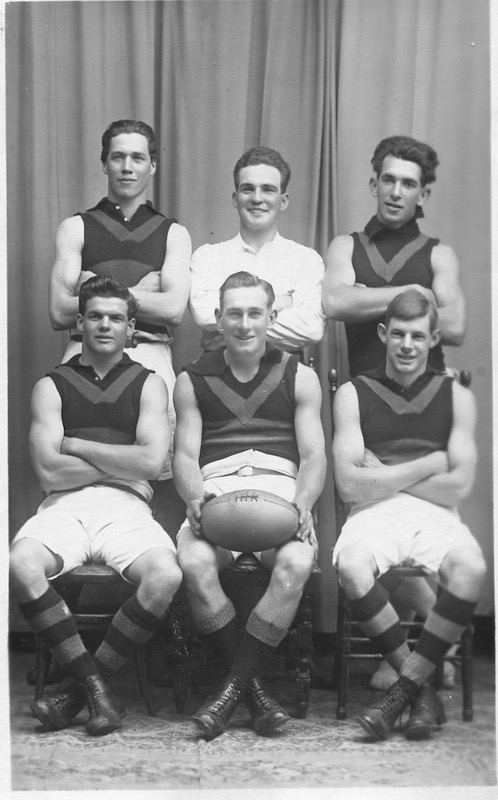
• Boulder City players circa 1925: Back: Jack “Chook” Milner, C Martin, Don Marinko. Front: P Hopkins, “Jazz” Richards, G “Nana” Dowson.
Bill Colgan was a highly rated player for Boulder and Mines coaching the latter to a premiership in 1955. His younger brother John, also played for Boulder before going on to play 220 games for South Fremantle where he was a dual premiership player.
Jack Roberts played for Kurrawang, Railways and Boulder. He was a premiership player for West Perth in 1932
Jack “Taxi” Martin was one of the greatest Boulder City players. He won the GNFL fairest and best award in 1934 and was leading goalscorer in 1927, 1928 and 1930.
Don Marinko went from Boulder to West Perth where he played in three premierships during 234 games.
Gordon “Sonny” Maffina went from Boulder to Claremont and won the Sandover Medal in 1949. He was WA’s best player at the 1950 Carnival and was awarded the Simpson Medal.
Lin “Blue” Richards went from Boulder to East Fremantle where he won the Sandover Medal in 1931. He won the GNFL fairest and best award three times, was a premiership player for Old East in 1929 and played in consecutive losing VFL grand finals with South Melbourne1934-36.
Clarrie Reynolds was a star with East Fremantle when he headed to the Goldfields to coach Boulder City in 1936. He later coached Kalgoorlie to premierships in 1953 and 1954.
Jack “Chook” Milner was a skilful, laid-back Boulder City player who was the star of the 1928 grand final.
Rex Mitchell was secretary of the GNFL from 1927 to 1979.

