
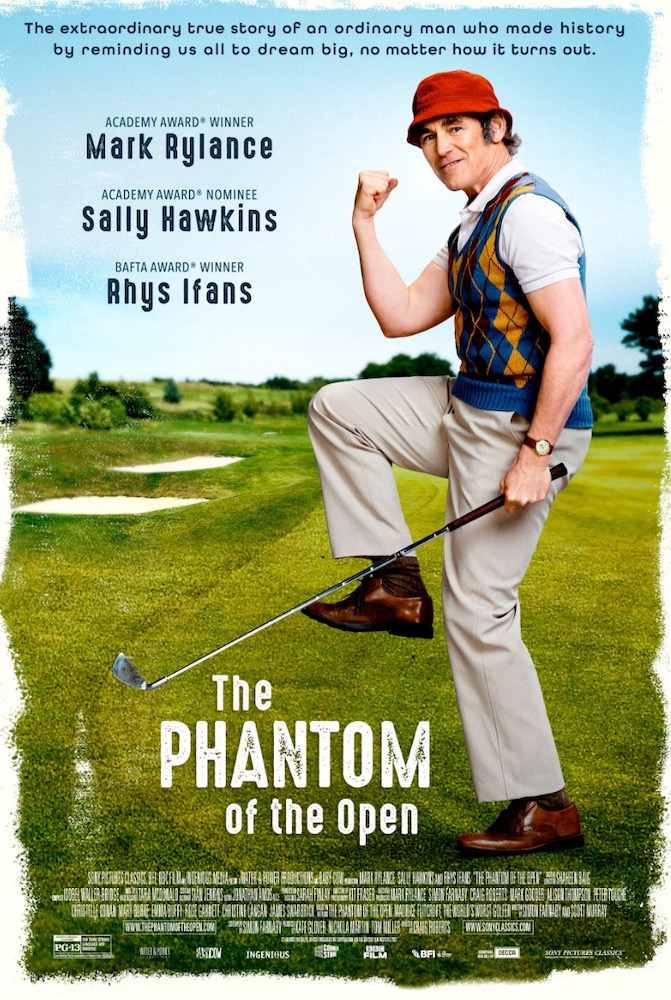
A look at The Phantom Of The Open
Not everyone has a fancy for sports movies or even those based loosely around sports events. But director Craig Roberts has assembled a great cast to tell the story of Maurice Flitcroft, a real-life character who somehow wrangled his way into the 1976 qualifying rounds of the world-famous British Open golf classic.
And to make this actual story all the more amusing and poignant is the fact that Maurice had never, ever played a round of golf in his life.
So how did Flitcroft (played by Academy Award winner Mark Rylance) get himself onto the hallowed fairways and greens of the Royal and Ancient Golf Club of St. Andrews? Well, he sees a round at St Andrews on his new-fangled TV set (with its remote) and watches US great Tom Watson winning the first of his British Open titles. Setting up a jar on his living room floor Maurice holes a lucky putt and reckons golf is his calling. He’s backed up by his family: wife Jean (Sally Hawkins) and three sons with the youngest two twins.
So in moving up the social scale from a shipyard crane operator in north-west England he does invest in a set of golf clubs. And begins some practice shots along the sandy beach shores of his home town. Mind you he does collect a few people out walking their dogs with a mis-directed golf ball or two.
But on and on Maurice practises, sends in his application – typed up by faithful Jean – and endures only one hiccup when a dutiful office secretary senses something is wrong. But she’s overruled by the abrasive secretary of St Andrews (Rhys Ifans) and onto the first tee strolls Maurice accompanied by two, fair dinkum golf pros. After many fluffed shots, balls driven into the woodlands beside the fairways and four or five putts on some of the greens Maurice hands in his card with the worst score ever recorded in a British Open: 121.
At home in the shipyards town word gets around that Maurice is out on the famous course and TV sets in pubs, working men’s clubs and private homes are tuned to his exploits. A sympathetic British tabloid reporter Ash Tandon is sparked by Maurice’s fumblings and reasons that a great story is ready for the picking. And despite being seen off St Andrews by the irascible club secretary and told never to return Maurice has other thoughts.
We see him return, though, in hugely amusing outfits. In one he’s French count Gerald Hoppy, a take-off of his shipyard managing director’s name, Gerard Hopkins. And according to the end credits he even tees off in one qualifying round as Arnold Palmtree. Why the organisers didn’t spot this play on words in absolutely baffling. Arnold Palmtree equals Arnold Palmer. Get it ?
So how did Maurice even get into the sport of golf in the first place? It seems that during World War 2 and like many children Maurice was sent away to a place where the risk of bombing from the German Luftwaffe wasn’t as great as in shipyard and port towns. He ended up with a family in Scotland and rambles across vast open spaces leads him to the fairways of a nearby golf course.
In a heart-tugging final chapter Maurice is guest of honour at a huge American golf club. He and his family are honoured at a special dinner and his words of tribute to wife Jean are especially touching.
And if you recall you’ve seen Mark Rylance in other recent movies, you’re right.
He won an Oscar at the Academy Awards for his role as 1950s Soviet agent Rudolf Abel in Bridge of Spies, was a south coast British seaman who used his pleasure boat to help in the evacuation of Dunkirk in the movie of the same name, and played Henry VIII’s up-and coming courtier Thomas Boleyn in The Other Boleyn Girl.
 australianrules.com.au